
OUR TRAVELS
Photos of sightseeing enthusiasts

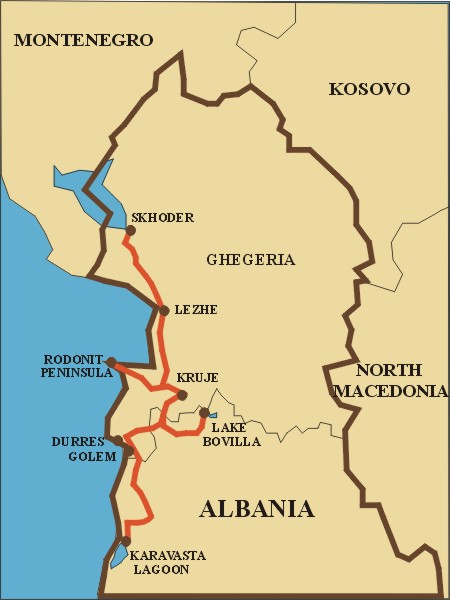
A TRIP ROUTE
INTERESTING STORIES
George Kastriota (born 1405 in Kruja, died 1468 in Lezhë), known as Skanderbeg, was an Albanian ruler and military commander considered one of the greatest generals of all time and an icon of the defense of Christianity and Albania. It was linked to the Kingdom of Poland by a common, though not always coordinated, fight against the threat from the Ottoman Empire. As a result of the uprising he initiated and led, Albania regained independence for a time (1444-1479). After the defeat at the Battle of Varna (1444) and the death of the Polish-Hungarian king, Vladislaus Jagiellon, the Transylvanian voivode, John Hunyadi, became regent of Hungary in 1446. In 1448, Hunyadi decided to take action against the Turks, establishing contacts with Skanderbeg. With the support of the Wallachians, he gathered an army of approximately 25,000 men, but the Serbian despot Durad Branković (a vassal of the sultan) prevented Skanderbeg from joining Hunyadi. As a result, the Second Battle of Kosovo in October 1448 ended in his defeat, and this victory paved the way for the Ottomans to conquer the Balkans.

IT IS WORTH KNOWING
After regaining independence, Poland established diplomatic relations with Albania only in 1937. This was due to the lack of Polish settlement and any trade links with the country. Our diplomatic representative in Tirana was Władysław Gűnther-Schwarzburg, the ambassador from Athens, who received accreditation for Albania in 1937. In 1938, he attended the wedding of the Albanian King Zog I and the Hungarian Princess Geraldine Apponyi. During the interwar period, only a few Poles, primarily geologists and journalists, visited Albania. Oil deposits are being exploited in Albania, once significant in the history of oil production in Europe. These deposits were explored by Polish geologists Jerzy Strzetelski (1874-1943) and Stanisław Zuber (1893-1947), among others. The former undertook reconnaissance geological research immediately after World War I, while Lviv geologist Stanisław Zuber was employed by the Italian oil company Azienda Italiana Petroli Albania and conducted exploration work as chief geologist from 1929 to 1947. He discovered oil deposits in the town of Kucova, which supplied Italy with crude oil until the end of World War II, and subsequently Albania. (source: www.kworum.com.pl)

Albania - Ghegeria
June 2025

While traveling around the Balkan Peninsula, Albania made such a great impression on me that I decided to return. I explored much of the country, but because I was traveling alone and renting a car was uneconomical, many off-the-beaten-path destinations were inaccessible.
The opportunity arose during this year's vacation. I managed to book an all-inclusive vacation to Golem on the Albanian Riviera at a great price. Julek and I spent it relaxing and exploring the local attractions. As usual, I rented a car, so we could easily reach all the remote spots, focusing mainly on admiring the untouched nature. We especially enjoyed Lake Bovilla, and the climb to the nearby peak was worth the effort, as the scenery from the viewing platform was simply spectacular.Durres and Golem


Our hotel was located in the tourist resort of Golem, near Durres. As is usually the case, aside from wide, sandy beaches and a multitude of hotels and restaurants, there were almost no attractions. This unassuming town proved to be an excellent base for our excursions. Our first stop was the nearby town of Durres. Since I had already visited the city three years ago, I was able to show Julek around like a professional guide.
Karavasta Lagoon and Rodon Peninsula


The picturesque Karavasta Lagoon is a habitat for waterfowl, protected in the Divjakë-Karavasta National Park. Unfortunately, we only managed to observe a few herons, and even then from a very long distance. Fortunately, the situation was saved by a `pelican on duty`, with whom we took souvenir photos. The Rodon Peninsula was equally spectacular, although the ruins of Skanderbeg's castle, seen up close, were a bit disappointing.
Kruje and Lake Bovilla


The biggest attraction of the city of Kruje is the impressive ruins of a fortress, picturesquely situated atop a cliff. It was here that George Kastriota Skanderbeg, the Albanian hero of the fight against the Ottoman Empire, was born. The highlight of the day-long trip was a visit to Lake Bovilla, located in the Dajti Mountains National Park. A relaxing swim in the crystal-clear waters and the breathtaking panorama from the viewing platform were worth the effort of the climb.
Lezhe and Shkoder


A trip to Lake Skadar, located right on the border with Montenegro, was the longest trip during our stay in Albania. The picturesque views of the lake and the Accursed Mountains fully compensated for the hardships of the day's drive. In the city of Shkodër itself, we visited the medieval Rozafa Castle and the lead mosque. The ruins of the once-imposing fortress made a great impression on us, and Julek liked the secret exit the most.

Our favorite photos


