
OUR TRAVELS
Photos of sightseeing enthusiasts

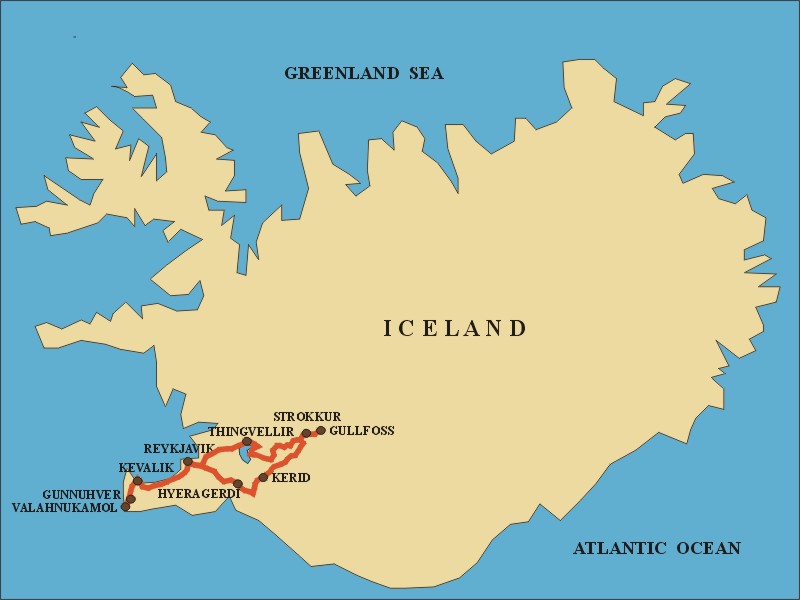
A TRIP ROUTE
INTERESTING STORIES
Democracy arose in ancient Greece, and parliamentarism in medieval Iceland. At the turn of the 9th and 10th centuries, the island was settled by Vikings, the men coming primarily from Scandinavia, and the women, as concubines, mostly from the British Isles. Initially, Iceland had a unique political system and could be called a land of equal and free citizens. During this time, the institution of the Althing, an assembly representing the entire island with legislative and judicial powers, was established, meeting on the Assembly Plain known as Thingvellir. The first Althing was held in 930, and the tradition of Icelandic parliamentarism dates from that moment. By the Althing's decision, the island converted to Christianity in 1000, and in the following years, the first bishoprics were established. In the 13th century, Iceland came under the rule of the King of Norway, and from the late 14th century until the present day, it has been under Danish rule. The agreement linking Iceland and Denmark in personal union expired in 1943. In 1944, the Althingi unilaterally decided to terminate the treaty, and in a referendum, a vast majority of citizens voted for Iceland's full independence.

INTERESTING FACTS
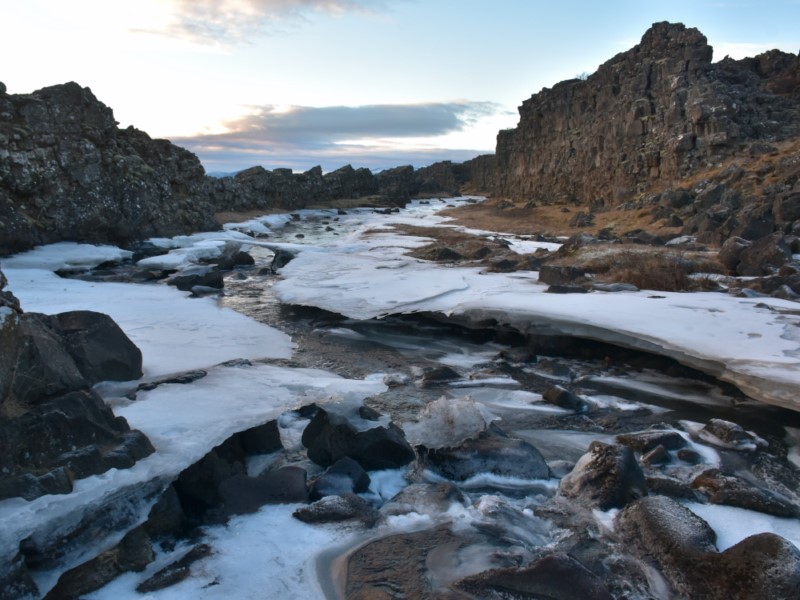
The Almannagjá Gorge in Þingvellir National Park is primarily known for its tectonic plates, the North American and Eurasian continents. The continental rift is visible above sea level, allowing tourists to walk between the two continents. It is also familiar to fans of the TV series "Game of Thrones," as many key scenes were filmed here. One of the park's main paths runs through the gorge, and the water flowing through it comes from the Oxara River, which flows into the rift through the Oxararfoss waterfall. Legend has it that the waterfall has magical powers and can foretell the future. At midnight on New Year's Eve, it turns red, and the cascade turns into wine or blood. Wine is said to herald prosperity and good fortune, while blood warns of war and misfortune. The Öxara River also has its own dark history. Near the waterfall, is Drekkingarhylur (Drowning Pool), which historically served as a place of execution for women. From 1564 to 1830, death sentences were carried out there by drowning in a sack, in accordance with strict Icelandic law. Women were primarily convicted of crimes of morality, including infanticide, adultery, and incest. The site contrasts with the picturesque surroundings, reminding us of the strict customs of ancient Iceland.
IT IS WORTH KNOWING
In 2026, Poles remain the largest national minority in Iceland, constituting approximately 6% of the country's total population. The number of people of Polish descent on the island remains at over 23,000, representing approximately 38% of all immigrants and the most sought-after group by employers. The average salary in 2024 was approximately ISK 845,000 (approximately EUR 5,860) gross. Iceland became a migration destination for Poles in the 1980s and 1990s, but a significant increase in emigration occurred after 2004, when it joined the European Union. Icelanders no longer required a work permit; an ID card or passport was sufficient. Initially, Iceland was an island of dreams for better earnings, a place where one could quickly save money and return home with their savings. Today, however, not only is the generation of emigrants changing, but above all, their motivations are changing. Iceland attracts those seeking work-life balance. The country offers a relaxed pace of life, closeness to nature, and a more open and tolerant society. This encourages young Poles not only to stay here longer but also to consider settling there permanently. (www.icelandnews.is)

UNIQUE VISITORS
Iceland
February 2026

I went to Iceland with my son to admire the Northern Lights and see the island in its winter wonderland. Unfortunately, we weren't lucky and didn't see any lights or snow. To make matters worse, we were plagued by bad luck throughout our stay, which took away from the joy of sightseeing.
On my first day, I caught a cold. A persistent runny nose, sore throat, and general weakness forced us to adjust our sightseeing schedule. Throughout the trip, I experienced constant technical problems with the rental car, which gave me a headache. When we returned home, and I thought the bad luck was over, it turned out that the camera card had been damaged, making the photos from my trip inaccessible. Fortunately, after several hours of painstaking efforts, I managed to recover them. I think that with time, we will forget these unfortunate events, and only the /strong>raw beauty of this wild country will remain in our memories.Golden Circle


We've barely scratched the surface of Iceland, and it's already captured our hearts. First up was Thingvellir National Park, a Unesco World Heritage Site. Besides its picturesque views, its greatest attraction is the opportunity to observe the meeting point of the Eurasian and North American tectonic plates. Also impressive are the Strokkur geyser, part of the Golden Circle, and the spectacular Gullfoss waterfall.
Reykjavik and surrounding


Due to my cold, we had to significantly cut short our planned excursions for that day. Iceland's capital, Reykjavik, impressed us as a provincial town, and aside from the modernist church Hallgrímskirkja, resembling basalt columns, nothing caught our eye. An interesting attraction was the water-filled crater of the Kerid volcano, where, thanks to its excellent acoustics, music concerts are held.
Reykjanes Peninsula


The Reykjanes Peninsula is a rarely visited destination, with most tourists heading straight to the capital or the east of the island. Vast lava fields and the cones of extinct volcanoes radiate a magical charm. A highlight of this place is the Eriksson Bridge, which spans a cleft between the continental plates. The icing on the cake, however, are the cliffs and rock formations of Valahnukamol, mercilessly lashed by foaming waters.
Iceland through Julek's eyes


Julek has been taking photos with his camera during family trips for several years now. I sometimes selected his photos for publication on our travel website, but it wasn't until this year that he asked me if he could post his photos in a separate section of the website. He selected all the photos himself, and I only helped him prepare the HTML code. And here's the result - Iceland through my son's lens.

Our favorite photos


