
OUR TRAVELS
Photos of sightseeing enthusiasts

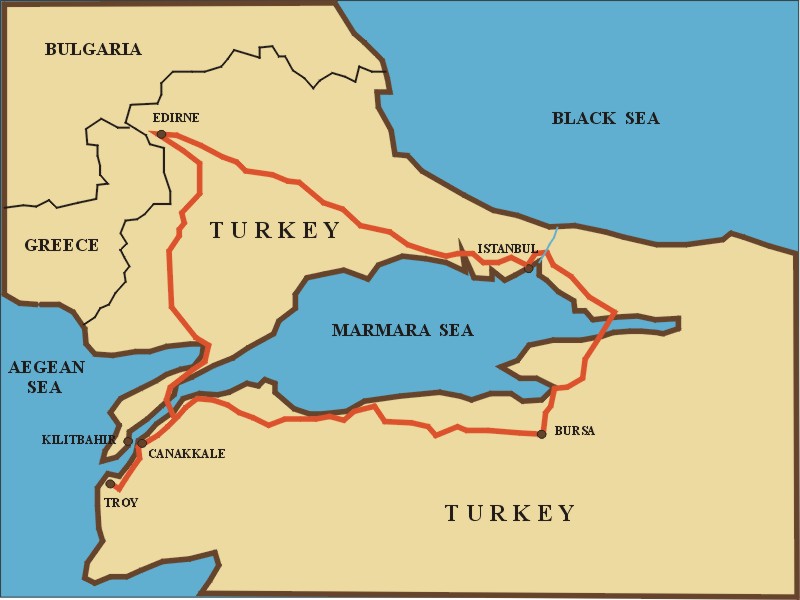
A TRIP ROUTE
INTERESTING STORIES
Residents of the Polish-Lithuanian Commonwealth were most often brought to the Ottoman Empire as prisoners of war, captured during the holy wars against the infidels, or captured by the Tatars and later sold at markets. A similar situation arose with the famous Roksolana, wife of Suleiman the Magnificent. Roksolana was the daughter of a Ruthenian Orthodox priest, Lisowski, from the town of Rohatyn, located in Red Ruthenia, approximately 80 km from Lviv (then part of the Polish-Lithuanian Commonwealth). Taken prisoner during the Tatar invasion of Rohatyn around 1520, she found her way into the Sultan's harem. She so appealed to the Sultan that she became his wife, the first woman in the history of the empire to wield such a powerful influence on state policy. Fiercely ambitious and power-hungry, she led to the murder of Suleiman's eldest son, Mustafa, and the Grand Vizier, Ibrahim. This ensured the succession to the throne for one of her sons, who later reigned as Selim II (Selim Opój). Roxelana never forgot her origins, corresponding with Queen Bona and maintaining Turkish-Polish relations. She died in 1558 and was buried in Istanbul, near the Mosque of Suleiman the Magnificent.

IT IS WORTH KNOWING
Adam Mickiewicz arrived in the Ottoman Empire in the autumn of 1855, and his stay was associated with political and military activities. The main purpose of Mickiewicz's trip to Istanbul was to organize Polish units, the so-called Polish Legions, which were to take part in the Crimean War on Turkey's side against Russia. While in exile, the poet believed that the involvement of Poles in this conflict would contribute to Poland regaining its independence. He collaborated in this regard with, among others, Michał Czajkowski (Sadyk Pasha). Mickiewicz became deeply involved in his work, organizing units and conducting diplomatic activities. Living conditions were difficult, which took a toll on his health. The poet died suddenly on November 26, 1855, in Istanbul, likely from cholera. The house in which he lived and died, located in the Beyoğlu district, has been converted into a museum. His body was temporarily buried in the cemetery in Pera (present-day Beyoğlu), then in 1861, transported to France and interred at the Les Champeaux Cemetery in Montmorency, to be finally laid to rest in the Crypt of the Distinguished at Wawel Castle in 1890. (source: www.wikipedia.org)

IT'S WORTH SEEING
The heroic epic The Iliad, whose authorship is traditionally attributed to the Greek wandering poet Homer (8th century BCE), has undergone numerous literary, theatrical, and film adaptations. The Iliad's universal content and realistic portrayal of human passions make it a work that remains relevant and compelling for contemporary audiences. In the 20th century, the epic inspired numerous feature films, animated films, and television series. However, one of the most famous adaptations is the 2004 feature film Troy, directed by Wolfgang Petersen and featuring unforgettable performances by Brad Pitt and Orlando Bloom. The film received an Oscar nomination for Best Costume Design and two MTV Movie Awards nominations for Best Actor (Brad Pitt) and Best Fight (Achilles vs. Hector). What I most enjoyed were the expansive, dynamic fight scenes, as well as the realistic sets and costumes. I remember the film making an incredible impression on me, and I watched it several times, each time experiencing the emotions and drama of the main characters.

Turkey - Marmara Region
October 2025

When the opportunity arose, I decided to leave in early autumn. At this time of year, due to the weather, the number of available destinations in Europe is very limited. I finally decided to visit the Marmara region in Turkey, as the forecast was very optimistic and promised sunny weather.
To my great dismay and disappointment, I was greeted by storm clouds upon arrival. I explored picturesque Bursa in the rain, and it didn't get much better after that. In total, I only had two sunny days during my entire stay in Turkey. Fortunately, I managed to visit most of the places I planned to see and take lots of great photos along the way. A small consolation was the fact that I had purchased tickets for a direct flight from Krakow to Istanbul with LOT Polish Airlines at a very attractive price.Byzantine Istanbul


Contrary to appearances, Istanbul has many monuments from the Byzantine era, although most churches have been converted into mosques. I must admit that visiting the most famous of them, the Hagia Sophia, was a bit disappointing. This was due to the fact that non-Muslim tourists can only admire its interior from the gallery surrounding the nave. I fully compensated for this in the Chora Church, where beautiful mosaics and frescoes from the period have been preserved.
Ottoman Istanbul


Istanbul boasts a wealth of attractive buildings, crafts, and valuable works of art, collected during the Ottoman Empire's over 600-year history. Many of them, like the Blue Mosque and the Süleymaniye Mosque, are Unesco World Heritage Sites, but nothing compares to the Topkapi Palace. The Harem, Throne Room, Divan, Treasury, and elegant pavilions and sultan's apartments captivated me with their lavish decor and furnishings.
Bursa


I explored the first capital of the Ottoman Empire, Bursa, in the rain, which fell with varying intensity throughout the day. Everything around me was gray and gloomy, and so was my mood. Even the picturesque view of the old town from the walls of the Tophane Fortress didn't improve my mood. Finally, I visited the Great Mosque, dating back to the late 14th century. The monumental interior made an incredible impression on me, and I must admit that the temple fully deserves its name.
Canakkale i Kilitbahir


During the journey to Canakkale, the weather cleared up considerably, which immediately lifted my spirits. After a short walk, I took the ferry to Kilitbahir, located on the other side of the Dardanelles. The narrowest section of the Dardanelles, formerly known as the Hellespont, has been a crossing point between Europe and Asia since ancient times. A visit to the forts of Namazgah and Rumeli on Cape Gallipoli, transported me back to the battles fought there, during World War I.
Troy


When you visit the ruins of an ancient city like Troy, you might be disappointed to find yourself confronted with the clumsy archaeological site. But a little imagination is all it takes to transform the otherwise unassuming ruins into a vibrant place. Fortunately, I had previously visited the newly opened, interactive Troy Museum, where I learned about the history of the region and the city and saw its visualizations throughout history.
Edirne


In Edirne, the weather had deteriorated again, but that wasn't my only concern. To my great disappointment, the city's biggest tourist attraction, the Selim Mosque complex, was undergoing renovation. Naturally, I had to settle for visiting other mosques, of which there are plenty in the second capital of the Ottoman Empire. A visit to the center of traditional Turkish wrestling, Kirkpinar, on Sarayici Island, was an interesting experience.

Our favorite photos


